I believe that the closer you get to yourself on the saxophone (in terms of your set-up, i.e. your saxophone, your neck, your mouthpiece, your ligature, your reed, etc.), the more impact it will have on your ‘sound’.
I want to point out the importance of you in that equation; your embouchure, tongue position, and air column thrust will ultimately replace the impact of any accessory (no matter how heavy your ligature screw is).
Now, as for the neck, it is essentially an extension of the saxophone’s tapered tube and the first point of entry for your air stream after the mouthpiece. So logically, its performance will affect everything below it… which is everything. In my opinion, there are three important factors in the design of a neck that will affect its response.
The inner diameter: the internal dimensions of the bell and the way it tapers affect overall efficiency. A larger tube means that the neck will have a higher ceiling in terms of volume and flexibility, but it will need more air overall. A smaller tube is more efficient and controlled, but over time it will reach its maximum in terms of volume and range.
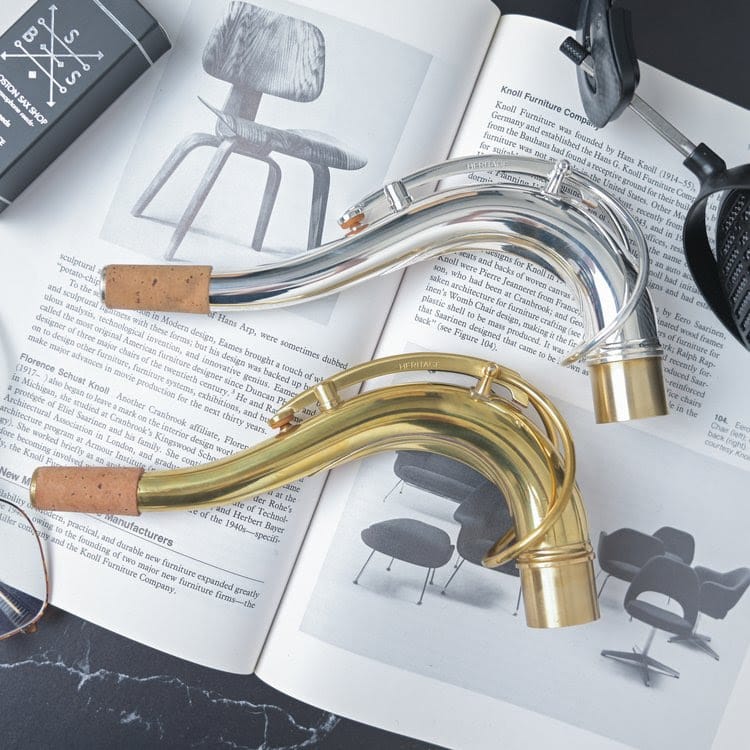
The angle: A neck that rises higher (like the Heritage) will decrease resistance. Imagine a garden hose that bends and then straightens. The same amount of water will flow much more easily through the straighter section. Similarly, a neck with a higher angle will have a better response.
The octave hole: The placement of the octave hole in the neck is essential, as it must divide the octave and keep the neck in tune.
From the Boston Sax Shop website:
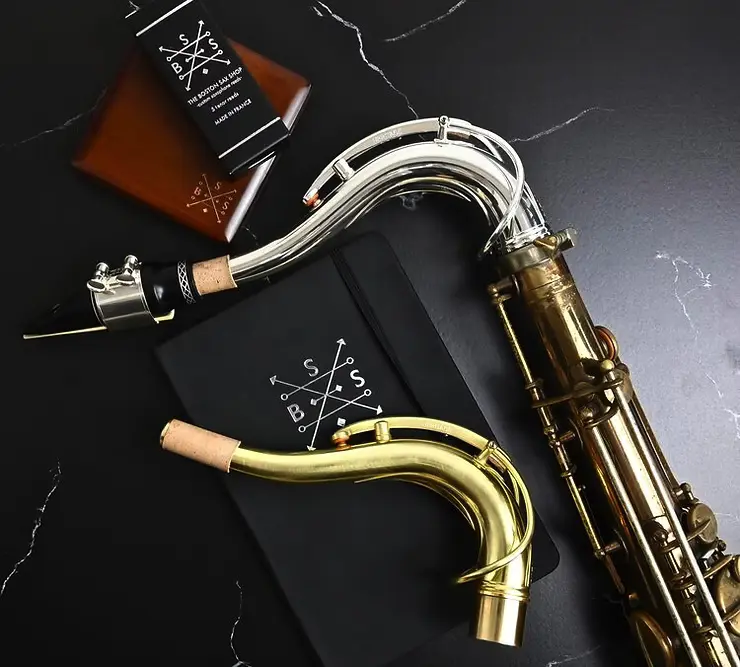
The Heritage tenor saxophone neck was conceived from my two passions: restoring antique saxophones and playing them. As a repairer, I have had the privilege of examining and testing hundreds of vintage necks and incorporating the best features of each into the design of the Heritage neck. A significant influence on this neck comes from the ‘free blowing’ characteristics I have found in vintage Selmers, such as the Radio Improved and Balanced Action models, which have necks with more open angles. These models are becoming increasingly difficult to find, and often people prefer their sound but not their ergonomics, so I set out to produce a neck that would allow musicians to experience the magic of these antique saxophones on more standard instruments. After several years of measuring and adjusting the angles of the neck, and many prototypes, the Heritage neck was born.
The Heritage neck sounds more flexible and has more amplitude than a standard Mark VI-style neck without sacrificing control or tuning. Due to its greater angle, it also gives the sensation of blowing further down the saxophone, which reduces resistance. I find that the Heritage neck gives the musician more space to push the air and opens up the mid-range, which is often more muted on the tenor, producing a more consistent sound throughout the saxophone. It is the neck of my dreams, and I am proud to share it with you.
-Jack Tyler, owner and repair technician
Heritage necks are manufactured with precision and exact tolerances to ensure consistency, and are individually hand-engraved.
At our workshop in Boston, before being sent to our premises in Barcelona, the neck can be adjusted free of charge to fit the following models: all vintage Selmer models, all current Selmer models, Yanagisawa, Yamaha, P. Mauriat, Cannonball, Eastman and all other saxophones manufactured in Taiwan. That said, there may be millimetre differences in diameter that need to be adjusted by a local technician, who will have the neck and body of your saxophone at their disposal.
Here are the links to the necks Heritage:
http://brass-market.com/producto/neck-heritage-boston-sax-shop-para-saxo-tenor
http://brass-market.com/producto/neck-heritage-boston-sax-shop-para-saxo-alto